Tourism Marketing in Brighton & Hove: Brighton is Busy
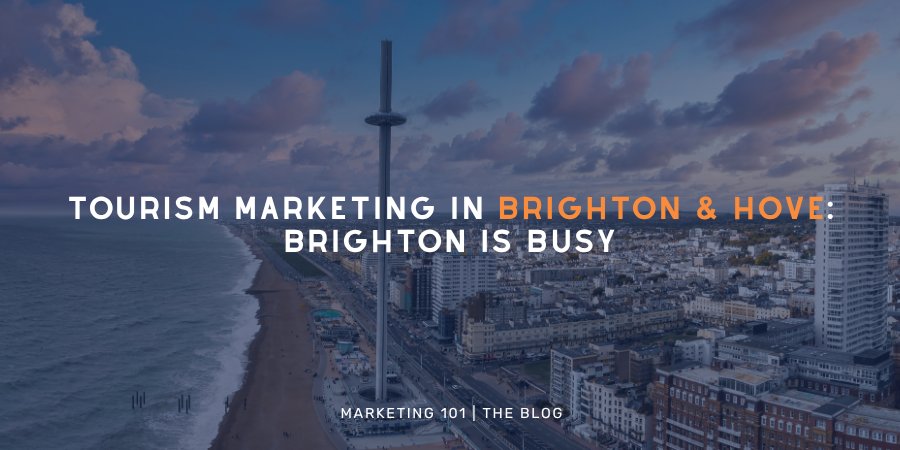
Brighton already has the visitors. The marketing opportunity is what happens next.
Brighton doesn't exactly struggle to get noticed. On a sunny Saturday, you only need to try getting through North Laine or finding a spare patch of beach to know that.
The numbers back it up. Brighton & Hove attracted around 12.2 million trips in 2024, generating an estimated £1.393 billion for the local economy and supporting more than 25,000 jobs. But if I were running a hospitality or tourism business here, the figure I'd be looking at particularly closely is the split between day and overnight visitors: 10.5 million day trips compared with just 1.7 million overnight trips.
For me, that points to one of the biggest marketing opportunities in the city. Brighton is already attracting millions of people. The challenge for individual businesses is getting a greater share of that visitor spend, encouraging people to stay for longer and finding good reasons for them to return outside the obvious summer weekends.
There is a wider economic backdrop to consider too. Domestic travel demand is still strong, but people are being more selective about what they spend. VisitBritain reported a fall of around 3% in domestic overnight trips in England during 2025, while tourism day visits increased. Overall expenditure rose, although higher prices account for some of that growth.
Consumer appetite for travel certainly hasn't disappeared. In summer 2026, around three quarters of UK adults said they intended to take a domestic overnight trip during the following 12 months. At the same time, weather, cost of living pressures and the rising cost of holidays and leisure were all influencing decisions.
For hospitality operators already managing higher wage bills, food costs, energy, business rates and the day-to-day realities of running a venue, this matters. Marketing can't simply be a stream of content and activity that looks busy. It has to earn its keep.
A busy destination doesn't guarantee a busy business
One of the challenges of operating in a successful destination is that it's very easy to assume some of the marketing job has already been done for you.
To an extent, it has. People know Brighton. They want to visit Brighton. There is a very substantial visitor economy already here.
What isn't guaranteed is where those visitors spend their money once they arrive.
Think about somebody getting off a train at Brighton station on a Friday afternoon. They still have a surprising number of decisions to make over the next 24 or 48 hours. They'll choose where to eat and drink, what to visit, where to shop and how much of the city they want to explore. A day visitor may decide whether to stay for dinner before heading home. Somebody here for an event may spend almost nothing outside the event itself, or they may turn it into a full weekend.
A restaurant isn't only competing with another restaurant in that context. It's competing for a share of someone's time and discretionary spend. Hotels, attractions, shops, bars and venues are doing exactly the same.
It's why I'd spend less time worrying about what to put on Instagram next Tuesday and more time understanding the point in a visitor's trip where a particular business becomes relevant.
For a hotel, showing a lovely bedroom is useful, but it only tells part of the story. Show somebody what they could do on Friday afternoon, where they could eat that evening, what Saturday morning looks like from your part of the city and how easy Sunday becomes when they don't have to rush home, and you're helping them imagine the stay rather than simply showing them the room.
Restaurants can think in much the same way. "Sunday roast served from midday" gives somebody information. Positioning that Sunday lunch as a great way to finish a weekend in Brighton before heading back to the station gives it context.
That understanding of the wider trip is where a lot of tourism marketing gets more interesting.
Value is going to matter more
With consumers watching their spending, hospitality businesses understandably look for ways to stimulate demand. Discounting is often the quickest option, but I'd be wary of reaching for it every time bookings soften.
Regularly taking 20% off a product has a habit of changing what customers think the product is worth.
There's a bigger job around communicating value properly, particularly when people are making more considered decisions about leisure spending. Value will look different for every business. For a hotel it could be location, breakfast, parking, late checkout or a genuinely brilliant view. A restaurant may justify the spend through its produce, service and atmosphere. For a family attraction, the important thing may be helping parents understand what's included, how long they'll spend there and what else they can do nearby.
The marketing job is to reduce uncertainty around the purchase. Somebody considering a £180 room shouldn't have to work out for themselves why it is worth £180, and a potential customer shouldn't have to hunt around a website to find out what's included in a ticket or whether a restaurant is suitable for their family.
Photography and video play a part in this, as do reviews, clear information and social proof. In tourism, however, there is another element that is easy to overlook: helping somebody understand how the business contributes to the experience they're hoping to have.
That's far more persuasive than simply describing something as "great value".
We need to get better at borrowing each other's customers
One of the biggest opportunities I see in local tourism is collaboration between businesses serving the same visitor.
We naturally think about competitors. What gets less attention are all the businesses that have access to exactly the customer we want, but are selling them something completely different.
A hotel guest needs somewhere to eat. Somebody having dinner may want a bar afterwards. A family spending the afternoon at an attraction still needs lunch. A person travelling to Brighton for a concert may need accommodation, while a conference delegate has evenings and potentially an extra day to fill.
Brighton is particularly well suited to this because so much of the visitor experience exists within a relatively small, walkable area.
Yet tourism and hospitality businesses can still end up marketing themselves in isolation.
A hotel having good relationships with nearby restaurants, attractions, shops and venues makes commercial sense. So does a restaurant understanding what's happening at the nearest theatre, music venue or conference centre. None of this has to mean complicated packages, commission arrangements or large joint campaigns.
It might be as simple as a hotel and several nearby restaurants creating a genuinely useful guide to eating locally. A theatre and bar might help audiences plan before and after a performance. An attraction could work with surrounding cafés and shops on a family itinerary. Businesses can also amplify useful local content rather than everyone independently trying to produce endless amounts of their own.
This has come up repeatedly in conversations we've been having around Brighton's visitor economy. There is no shortage of opportunity to collaborate, but the reality of hospitality is that operational issues have a habit of taking priority. If you're short-staffed today, planning a campaign to improve demand three months from now understandably slips down the list.
Unfortunately, that's also how marketing becomes reactive. Businesses promote hard when Brighton is already busy and start thinking about quieter periods once they've arrived.
Activities such as October Unpacked, created through the Brighton & Hove Tourism Alliance to help drive activity later into the season, shows what can happen when businesses start tackling a shared seasonal challenge collectively. It doesn't remove the need for individual marketing, but it creates something bigger for individual businesses to plug into.
We need more of that thinking.
Brighton's events calendar is already creating demand. Use it properly.
Brighton has a significant advantage over many destinations because there are reasons to travel here throughout the year.
Brighton Festival, Fringe, Pride and The Great Escape are the obvious examples, alongside football, conferences, university events, theatre, comedy, major concerts, Christmas activity and a huge number of smaller events.
Each of them brings an audience into the city.
The missed opportunity is when hospitality businesses treat those events primarily as things to post about rather than sources of demand to plan around.
If an event is likely to bring thousands of people into Brighton, the useful work starts well before the event itself. Businesses need to understand who is likely to attend, where they're coming from and when they'll start planning. From there, you can look at what they might need before and after the event, whether there is an opportunity to encourage an earlier arrival or an extra night's stay, and which other businesses are serving the same audience.
Looking at the calendar this way takes it beyond social media and into something much more commercially useful: demand planning.
A restaurant close to a major venue should already know its biggest event dates for the year. Hotels should be thinking about Pride audiences long before July arrives. The same applies to conferences, concerts, university activity and the quieter events that may not dominate the city but could be commercially significant to businesses within a particular part of it.
Put the major dates into the annual marketing plan and work backwards from when the visitor is likely to make their decisions. By the time they're already in Brighton, a lot of those decisions have been made.
Social media is important, but it isn't the whole customer journey
Tourism works brilliantly on social because it's visual and emotional. People want to see the room, the food, the view and the atmosphere in a restaurant at 8pm on Saturday. Good video and photography allow somebody to picture themselves there in a way that a list of facilities never can.
The danger is allowing social media to become synonymous with marketing because it's the most visible part of what the business is doing.
A Reel can create interest, but that interest disappears pretty quickly if the customer then searches for the business and finds incorrect opening hours, an old menu or a website that is painful to use on their phone.
In reality, the journey might stretch across several channels and several weeks. Somebody sees a business on Instagram, searches for it later, reads the reviews, checks the menu, talks to whoever they're travelling with and eventually returns through Google Maps to make the booking. None of that is unusual.
It's worth periodically going through that process yourself as though you've never encountered the business before. Search on your phone, look at what appears in Google and check whether the photographs, reviews and practical information reflect the experience you want to sell. Then go through the website and booking process. If you're a hotel, make sure there is a clear reason to book direct rather than simply assuming the customer will do so.
AI is beginning to add another layer to travel planning as people use tools to ask increasingly specific questions about where to stay, eat and spend their time. Someone might ask for a restaurant before a show at Theatre Royal Brighton, a rainy-day weekend itinerary with teenagers or a hotel close to independent restaurants and the beach.
I wouldn't overreact to that or announce that Google is suddenly irrelevant. What it does reinforce is the need for good information online. Businesses need to be clear about where they are, their opening times, accessibility, who they're suited to, what is nearby and what makes the experience distinctive. Practical information such as whether dogs or children are welcome, how easy you are to reach from the station and what someone can do nearby becomes valuable in more ways than one.
Good information has always helped people make decisions. Increasingly, it also helps the technology they're using to make recommendations.
Existing customers are an underused tourism audience
Tourism marketing quite naturally puts a lot of energy into finding new customers. What sometimes gets overlooked is how valuable a previous customer can be.
Somebody who has already visited Brighton is easier to persuade to return than somebody who has never considered it. If they have also had a good experience with your business, you've removed another hurdle.
Hotels generally hold a significant amount of customer data. Restaurants using booking platforms often have more than they realise, and attractions, venues and events have ticketing and mailing data of their own. The value depends on what happens to it afterwards.
Sending everybody the same general newsletter is a missed opportunity if you already know something about why people visited.
A guest who stayed for Pride has told you something about their reason for travel. The same is true of a family booking during half-term, somebody attending a conference or a couple staying for an anniversary.
This doesn't require an enormously complicated CRM system. Sensible segmentation based on the reason for the original visit can go a long way. From there, think about what would give that customer a relevant reason to return.
Winning the second booking ought to be easier than winning the first.
The 10.5 million day visitors are an opportunity in their own right
I keep coming back to Brighton's day-visitor numbers because they change the way I'd think about the market.
Of course we want to attract new visitors to Brighton & Hove. But there is considerable value available from the people who are already choosing to come here.
Getting somebody who is already in the city to stay for dinner, add an attraction, explore another neighbourhood or return for a different event is a different marketing challenge from convincing somebody to choose Brighton in the first place.
Turning even a relatively small proportion of day trips into overnight stays would also have obvious value across accommodation, food and drink, entertainment and retail.
This is where destination-level thinking and individual business marketing overlap. Can a visitor be encouraged to make a day trip into a stay? Could one night become two? Are there stronger reasons to explore Hove as well as the centre of Brighton? Can we make October, January or March genuinely attractive rather than relying overwhelmingly on the summer?
An event doesn't have to be the entirety of somebody's visit. It can be the starting point for a weekend.
The more local businesses understand what else their customers want while they're here, the easier it becomes to find those opportunities.
Where I'd focus first
For a tourism or hospitality business looking at its marketing now, I'd concentrate on four areas before adding more activity.
Start with the commercial gaps
Look at where you actually need more demand. That may be a quieter month, Sunday nights, midweek occupancy, an early restaurant sitting or a particular product or room type.
If Saturdays in August are already full, spending more money trying to make Saturdays in August even busier isn't necessarily the best use of the budget.
Marketing needs a specific commercial job.
Understand the visit, not just the visitor
Demographics have their place, but knowing that somebody is aged 35–44 is often less useful than knowing they're coming to Brighton for a concert, a family weekend, Pride, a conference or an anniversary.
Understand why people are travelling and look at what they do immediately before and after visiting your business. That is where many of the best content, partnership and referral opportunities sit.
Fix the journey to purchase
Look at social media, Google, reviews, the website, booking process and email communication as one connected journey.
Do it on a phone and be critical. Anything that creates unnecessary doubt or effort is worth addressing.
Then look at what happens once somebody has bought. Are you capturing useful data, staying in touch appropriately and giving them a credible reason to return?
Use more of what Brighton already gives you
The city already has a major events calendar, millions of existing visitors and thousands of businesses serving the same audiences.
Build your marketing around that reality.
Plan further ahead for the events that matter to your customers. Work with businesses that complement what you offer. Give existing customers reasons to return in different seasons and look closely at the periods when you need demand rather than concentrating all your effort on the moments when the city is already busy.
And measure it commercially. Reach and engagement are useful indicators, but bookings, covers, occupancy, direct bookings, average spend, repeat visits and revenue during the periods you're trying to grow tell you far more about whether the marketing is doing its job.
Brighton already has a lot to work with
Brighton & Hove has a globally recognised identity, major events, a strong independent scene, food and drink, culture, nightlife, heritage and the sea. Its visitor economy is worth well over £1 billion.
For hospitality businesses, there is a significant opportunity to get smarter about how that existing demand turns into revenue: understanding why people are here, being visible at the right point in their planning, making it easy to choose and book, and giving previous customers good reasons to come back.
I'd also put much more emphasis on collaboration. A hotel, restaurant, attraction, venue and independent retailer may all be serving exactly the same person during the course of one weekend. Treating each business as completely separate misses an obvious opportunity.
People don't experience Brighton one business at a time. They remember the trip as a whole. The better local businesses become at understanding their place within that experience, the stronger the commercial opportunity becomes.
Want to look at where your marketing could work harder?
We work with tourism and hospitality businesses on marketing that has a commercial job to do, whether that's filling quieter periods, reaching a different audience, improving the customer journey or getting much clearer about what makes the business worth choosing.
We're based in Brighton & Hove and understand the opportunities, and some of the challenges, that come with marketing a hospitality business in a busy visitor destination.
If you'd like a fresh pair of eyes on yours, get in touch with Marketing 101.